
People are reading less and less, and bookstores have become rare specimens due to technology, digital books, its the slow, painful death of the art of printing; I founded my own publishing house on September 7 of 2026, exhausted after knocking on the doors of so few publishers in hopes of publishing my manuscripts. My publishing house is the latest cultural, educational, and artistic arm of the Kunst Borroka Movement. When you cannot find someone to help bring great ideas to life, you must do it yourself, nothing stops a german. Kunst Borroka Publishing welcomes talented new authors in the genres of art, design, and narrative—just as the Kunst Borroka Museum of Modern Art and the Myasis art gallery do for new talented artists.
Concieved without love the curse of art
Synopsis
When someone speaks to you directly, it is either because they care for you and tell you the truth, or because they hate you and lie, hoping for your ruin. When Monica—the woman I loved—said to me: – “Kohn, few artists manage to make a full living from their work; you are talented—I never would have chosen you if you were an ass, I am very clear on that—but you could start a different career and life path that would allow you to earn more money; we could be happier”. Everything became clear to me in that instant. Monica would be replaced immediately by another woman; I would not give up art or graphic design. If she didn’t like the life we were living, she should change her job so she wouldn’t have to rely on me for support if she was dissatisfied with her own salary.
I decided to return home to my parents and maternal grandparents, saying goodbye to Monica forever. Forty-eight hours later, I was with my family; a week later, I had founded a specialized graphic design studio and a traditional animation production company. A year later, with my atelier fully set up, I began creating art on women cheap garments using clothing as a canvas to save as much money as possible. By reinvesting my earnings, I created three clothing brands—two of which specialized in designer fabrics—and founded my own modern art museum, a modern art gallery, and an informal school based on the German educational model in a country that was both beautiful and violent; I launched a major cultural, artistic, educational, and commercial movement. My grandfather was right when he taught me that a good woman is one who is independent, builds a future alongside her partner, and refuses to let financial trouble ruin love. I still haven’t found her.


Two collector’s editions:
- Limited edition of 50 copies signed by the author – € 330
- Standard edition of 150 copies – € 110
- Size 20 x 20 cms
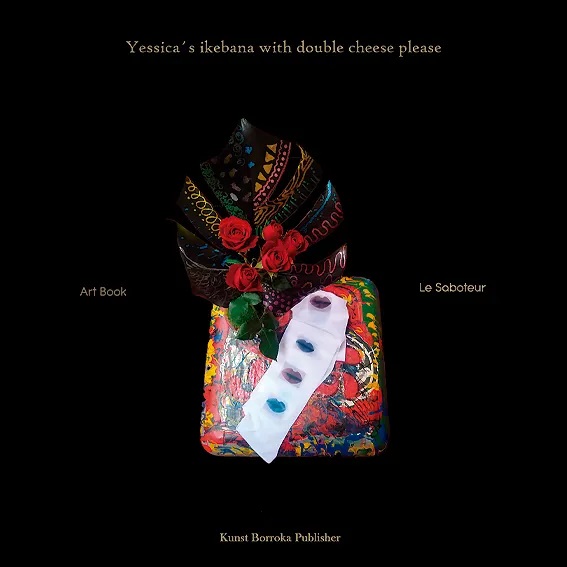
Yessica´s Ikebana with double cheese please
Second Le Saboteur artist’s book collector’s edition
Synopsis
It is 2024, and I am returning from Europe to reunite with my parents—coming back to our tropical retreat after a two-year separation caused by the COVID-19 pandemic. I decide to self-quarantine before seeing them again; upon landing, I travel immediately to the family country house in El Rosal, Cundinamarca. There, I spend the next two weeks transforming our vacation home into my atelier. During this time, I dedicate myself to cheesemaking—using milk from two cows I had acquired before the pandemic and following a family recipe. The cheeses are aged for sixty days, a method used during wartime.
I founded the artisanal cheese shop Carnivore, molding the cheeses into the shape of “one-kilo buns”—inspired by the buttocks of Sofía Vergara, a Colombian woman who to me, possesses great character and is the platonic mother of my children. Within my new post-pandemic universe lies a flower shop in the town center called El Portal. Its owner, Ms. Yessica Miranda, is a beautiful woman with black hair and thick eyebrows who loves floral design and has a fascinating fetish: she reveres dried flowers. She isn’t a goth; she doesn’t wear black, isn’t a fan of Type O Negative, and doesn’t have a pale complexion.
One afternoon, I bring her one of my cheeses, hoping to socialize and perhaps court her; I ask her about the Japanese art of Ikebana, and I end up discovering another side of her profession and devotion when she tells me she practices it whenever she can. Filled with hope, I make her a proposal: to design an Ikebana arrangement for my cheeses, uniting her flower shop with my cheese shop—working together to create something distinctly European in a tropical land.
So begins a wonderful journey that takes me back to the atelier—interrupting my vacation-quarantine—where my clothing brands will be born, where I will delve into artistic creation through collage, found my own modern art museum, one author fabrics brand, two women cloathing brands and bring to life my artistic, cultural, educational, and commercial movement: Kunst Borroka.
It does not matter that we didn’t have more time to get to know each other, or that the atmosphere around us wasn’t exactly conducive to romance—Colombia is a complicated country when it comes to peace.
Edition
- Standard edition – € 80
- 30 pages
- Size 20 x 20cms
International shipping costs are additional.
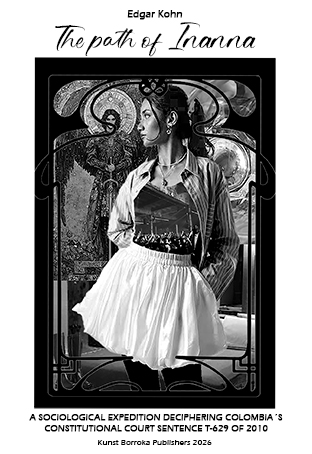
The path of Inanna
Inanna : ancient Sumerian goddess of love, war, fertility, and political power
Colombia is the only Latin American country that, like Germany, Austria, and Switzerland, has labor and social legislation for female sex work that guarantees workers their rights and statutory benefits—such as social security, pensions, occupational risk insurance, and severance pay. A sex worker has the same constitutional rights as a lawyer or a judge.
Le Saboteur traces a path through the Colombian adult entertainment industry while seeking non-professional models for the creation of his artistic visual and textile works. Like Spain, Colombia remains a country of contradictions—technically underdeveloped in certain respects, where modeling work is still viewed as a front for prostitution at all levels, despite having been constitutionally modern and civilized since 2010.
Sex workers carried out their work without social or labor protections from the Colombian state; there were no constitutional laws in their favor, and sex work was associated with extreme marginalization. In this regard, Colombia was an uncivilized country.
All this changed in 2010, when the Constitutional Court of Colombia drafted and approved Ruling T-629 of 2010 and its annexes, responding to the demand to legalize voluntary sex work for adult Colombian women.
This ruling grants sex workers the same social and labor rights as women working in other trades or professions.
Colombian social attitudes and double standards lead many women to forgo the provisions of Ruling T-629 of 2010—whether working independently or as staff in a legal establishment—as they avoid becoming legal sex workers.
Edition
- Standard edition – € 25
- 100 pages
- Size 10,5 x 14,8 cms
- Black and white illustrations
International shipping costs are additional.
Reserve your copy via our corporate email:
secretariaestudiodediseno@protonmail.com
Get a 5% discount during the month of September 2026 on the book’s pre-launch.

